The True American Revolution: That of the American Slave
Valentine Bentz #36.3
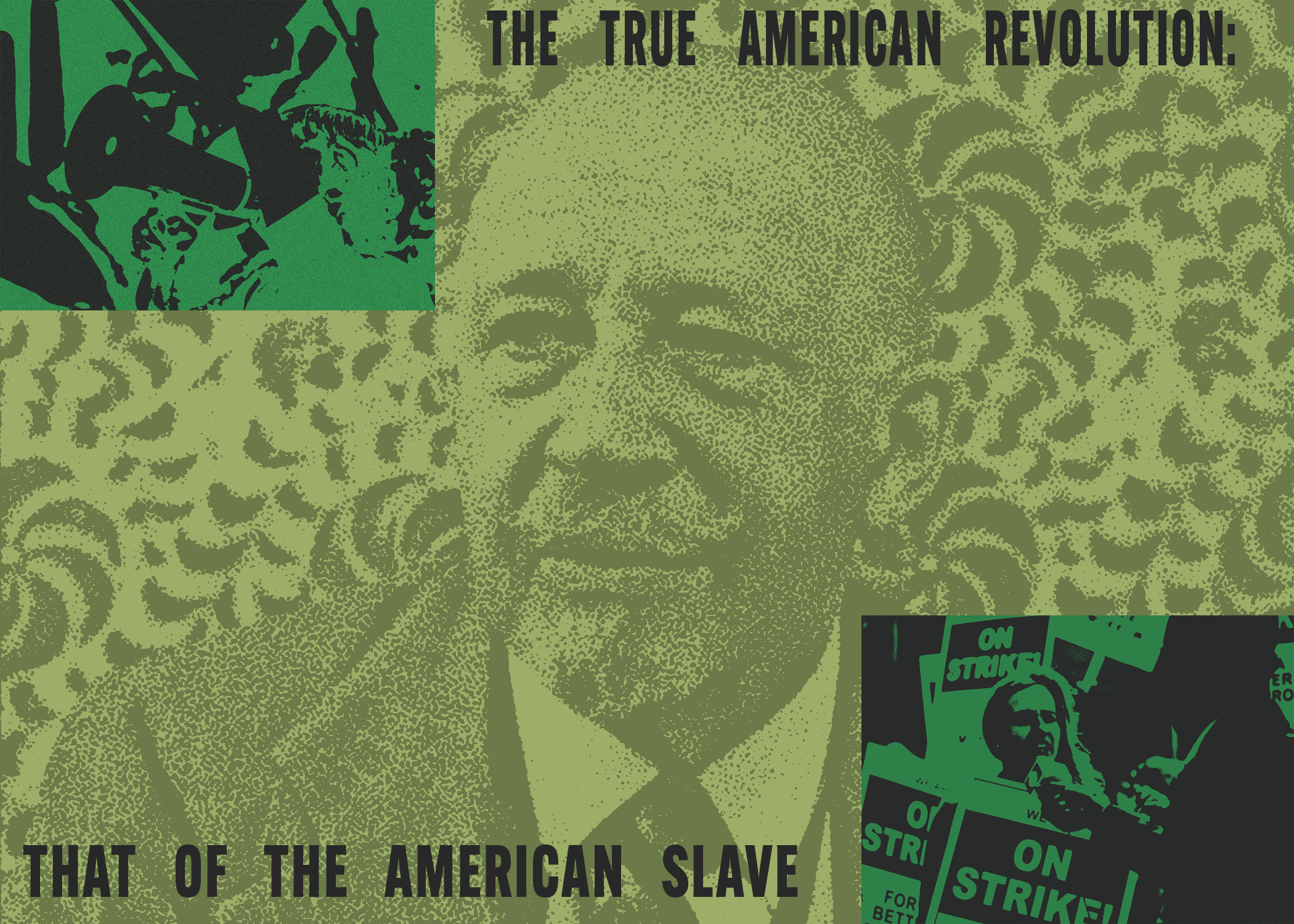 header by Alex(a) Cruz Abarca
The True American Revolution: That of the American Slave
Closing his magisterial work Black Reconstruction, W.E.B. DuBois reflects on the story of the American Slave: “The most magnificent drama in the last thousand years of human history is the transportation of ten million human beings out of the dark beauty of their mother continent into the new-found Eldorado of the West. They descended into Hell; and in the third century they arose from the dead, in the finest effort to achieve democracy for the working millions which this world had ever seen” (727). Significant to understanding this story as Du Bois does is the employment of a Marxist lens to see that the enslaved were not ‘freed’ by their oppressors during the civil war – rather they emancipated themselves in response to the intolerable conditions of slavery. Nearly a century earlier, as the United States broke away from the tyrannical English Monarchy in the well-known American tale, the Founding Fathers ironically became leaders of “the only nation in history whose best and brightest minds first led a revolution from colonialism in the name of life, liberty, and the pursuit of happiness for all men, and then built a contradiction into their society by explicitly denying human dignity to a quarter of the population they aspired to govern,” as James and Grace Lee Boggs posit in *Revolution and Evolution in the 20th Century *(156).
Given this, what does it mean that the actions of the Founding Fathers are memorialized as heading the ‘American Revolution,’ while the story of the slaves’ self-emancipation is rarely told, and if so, characterized by a uniquely American shame? Starting from here, this paper will contend that the slaves freeing themselves constitutes the true American Revolution, as it is what legitimately brought democracy—perhaps our nation’s fondest pillar—to the United States. In section one, I establish one way that revolution can be quantified, primarily utilizing the works of James and Grace Lee Boggs. I will then map this concept over the Slaves’ self-emancipation, using Du Bois’ work in Black Reconstruction to constitute it as such a revolution. In section two, I turn to how this revolution was cut short by the backlash of the Redemption era, ultimately giving rise to the total sabotage of Reconstruction. I conclude with implications for the present day in which we find ourselves facing rising fascism in the US, while also attempting to identify the next step in the genealogy of struggle set in motion by the Revolution of American Slave.
On Revolution, and that of The Black Worker (American Slave)
In order to determine what we call the true American Revolution, we must first define for ourselves what revolution is. Grace and James Lee Boggs’ Revolution and Evolution in the 20th Century offers a an analysis of qualifying factors that can indicate when a period of history is in fact a revolution. For them, a revolution is a specific method in which human evolution is advanced, specifically on the basis that the advancement “expands and enriches human identity” (22). Rather than an isolated or singular event predicated on spontaneity, such as a rebellion or revolt, revolution is a sustained, protracted struggle, firmly connected to the rest of history. It is “a phase in the long evolutionary process of man/woman [which] initiates a new plateau, a new threshold on which human beings can continue to develop…” (19). In times where evolution has been stalled, such as during the rule of an oppressive regime, revolution can restart it through an intentional projection of the future in which “a more human human being, i.e., a human being who is more advanced in the specific qualities which only human beings have—creativity, consciousness, and self-consciousness, a sense of political and social responsibility” (19) is able to exist. Overall, revolution most fundamentally gives people the ability to “renew and enlarge their own humanity” (22), ushering in a “profoundly new, profoundly original beginning” (19) for those who partake in it. Further, a revolution is not done by accident or through a stroke of luck, but through a consciousness of what one is doing; the Boggses emphasize that “a conscious struggle, that is, a struggle governed by conscious values, conscious goals, conscious programs and conscious persons, is required” (19). In other words, revolutionary actors, or an oppressed group, must envision the future and attempt to create it.
In sum, the Boggses argue that for a period to be considered a revolution, it must (1) expand and enrich human identity, (2) initiate a profoundly new historic threshold, and (3) be carried out by those with a revolutionary consciousness, set on shaping the new future at hand (where 1 + 2 have been achieved). These preconditions are intentionally broad, leaving room for the uniqueness of each revolution, understanding that they all unfold under very specific conditions that are developed over a number of years, at a “particular time and in a particular historical period, and which, therefore, cannot possibly be repeated at another time in another place” (24).
How then, can we see these preconditions fulfilled in the case of the American Slave? In the more than 150 years since their emancipation, they have been popularly characterized as passive agents, liberated by the Emancipation Proclamation and the Union Army, both which receive moral credit for finally ending the institution of slavery. Even in 1935, Du Bois was responding to this misrepresentation by establishing the existence of a Black Revolutionary Consciousness in Black Reconstruction – using a Marxist lens to better understand how the enslaved saw their own condition. As Marx first conceived that industrial workers would acquire a consciousness capable of overthrowing capitalism through becoming alienated from their labor and frustrated with their working conditions, Du Bois argues that it is crucial to consider the labor conditions of the Black Slave. Cedric Robinson cements this in Black Marxism, emphasizing that “it was not as slaves that one could come to an understanding of the significance [Black people] had for American development. It was as labor” (pg. 199).
In this line, Du Bois argues that the Slave was both self-aware as a slave and as a worker, arguing that they were not only alienated from themselves but also alienated from their labor; they were oppressed both on the conditions of their race and class. Thus ‘The Black Worker’ (the title of the opening chapter of Black Reconstruction) always understood their working conditions to be horrid, being the conditions of slavery. As workers, they also understood the power of their labor, which according to Du Bois was the “foundation stone not only of the Southern social structure, but of Northern manufacture and commerce, of the English factory system, of European commerce, of buying and selling on a world-wide scale…” (5).
On this basis, Du Bois goes on to argue that the enslaved undertook a ‘General Strike’ (the namesake of chapter four) in which they consciously rebelled against the conditions of their work by withholding their labor: “The slave entered upon a general strike against slavery by the same methods that he had used during the period of the fugitive slave… and it was also true that this withdrawal and bestowal of his labor decided the war” (57). As the Civil War progressed, Slaves—in coordinated efforts—refused their work, escaped from plantations and offered their labor in service to the Union Army as it reached the Confederate States. By ‘freeing’ to Union camps, they weakened the Confederacy’s ability to continue the war by crippling its labor force, military support, and economic stability:
Yet, these slaves had enormous power in their hands. Simply by stopping work,


they could threaten the Confederacy with starvation. By walking into the Federal


camps, they showed to doubting Northerners the easy possibility of using them as


workers and as servants, as farmers, and as spies, and finally, as fighting soldiers. And


not only using them thus, but by the same gesture, depriving their enemies of their use


in just these fields. It was the fugitive slave who made the slaveholders face the


alternative of surrendering to the North, or to the Negroes. (121)
Thus, the General Strike was a direct assault on slavery, the plantation economy, and the Confederacy itself. As Du Bois argues in chapter five (The Coming of the Lord), the North would not have won the war if the more than 200,000 enslaved did not free themselves and support the Union. Moreover, it was not until the North had an existential decision to make— allow Black people to fight and to take a moral stand against slavery or lose the war – that the Emancipation Proclamation was issued, leading to a turn in the war for the Union and steps towards Reconstruction for the whole nation.
In total, the Black Worker was in control of their destiny as a united revolutionary proletariat that freed themselves from their bondage, first as striking workers, and then as soldiers fighting for the union. As active participants in their liberation, or as Du Bois says, the “center of the stage**” **(ch 4, p. 57), the Slaves used the opportunity of the Nation’s miscalculation (assuming the enslaved were too uncivilized to take up any such action) to make the Civil War a moment of their own revolution. Their newfound freedom surely meant the expansion of human identity, as Slaves finally became human. They transformed themselves from sub-human (slave) to having autonomy over their own social, economic, and political lives (free), even if freedom was not as totalizing as it was for whites. Obviously, the denial of Black Humanity (the Negro Problem) was not wholly subdued by emancipation, yet it marked a profoundly new beginning—the Black Worker had made themselves free in the same land where they had been made a slave.
What did this freedom, and new beginning, mean for the nation as a whole? The aftermath of the Constitution Convention in 1787 revealed and polarized real contradictions within the Founding Fathers, namely the divide between the North and South over what was to be done about slavery. And yet, “In the interest of unity, [they] covered up the contradictions… thereby laying the groundwork for the Civil War” (156) as the Boggses note. Nearly a century later as this war raged on, Lincoln similarly sought unity at all costs. “He made no effort to appeal to an enlarged sense of human identity among those on both sides, to urge them to recognize the role which whites had played in bringing blacks to this country by force and hence their responsibility of developing a new society in which everyone could play an equal role” (162). Therefore, it was ultimately the Founding Fathers’, and later, the Union’s, failure to truly provide democracy that required a revolution by the slave to restart the evolution of the country. Through striking, freeing, and fighting, the enslaved lifted the grand contradiction cemented in our Nation’s framing: that all men were created equal and yet some were destined to be slaves. Similarly, Du Bois proclaimed that freedom being won meant the nation could finally be cleansed: “At last democracy was to be justified of its own children. The nation was to be purged of continual sin-not indeed all of its own doing-due partly to its inheritance; and yet a sin, a negation that gave the world the right to sneer at the pretensions of this republic. At last there could really be a free commonwealth of freemen.” (125-126).
On Counter Revolution and White Backlash
“The slave went free; stood a brief moment in the sun; then moved back again toward slavery,” – WEB Du Bois in Black Reconstruction (215)
Reconstruction saw the nation attempting to stitch itself back together as Black people began to take full advantage of their newly won civil liberties. Freedom rang powerfully. After generations of being owned, former slaves and their children were finally able to participate in the American promise of life, liberty, and the pursuit of happiness. Southern Reconstruction governments, many run by Black elected majorities, established institutions of free and public education and championed progressive legislative reforms. The South experienced an economic revolution, with the formerly enslaved working the land for themselves and acquiring capital through business. And yet one can recognize, as Du Bois did, that the easing of the contradiction perhaps only clarified the true nature of the United States: the nation’s democracy and opportunities were still predicated on the subjugation and oppression of Black people. This true nature was no more strongly on display than during what followed the “brief moment in the sun” – backlash strong enough to move the freed “back again toward slavery” (215).
For Du Bois, this backlash had a common root throughout the nation: shame. “The South was ashamed because it fought to perpetuate human slavery. The North was ashamed because it had to call in the black men to save the Union, abolish slavery and establish democracy” (711). Whites, still in hegemonic control and the superior position of the American racial caste, violently aimed their shame right back at those who had, just a moment earlier, delivered the country out of slavery and into the future. The Boggses are once again useful here, helping us to understand that while “The revolution creates the future; the counter-revolution seeks to maintain the present or restore the past. The counter-revolution is invariably anti-historical. It narrows and limits human beings…” (22). This anti-historical movement can be seen strikingly through the ideology of ‘Redemption’ that was commonplace (especially in the South) during Reconstruction.
Many ‘Redeemers’ were members of militia and/or terrorist groups that were established in the wake of emancipation, such as the Ku Klux Klan (founded 1865, only eight months after the conclusion of the Civil War), The White League (founded 1874), and Knights of the White Camellia (founded 1867). Though there were distinctions between each group’s make up and tactics, all shared a similar ideology of Redemption: that a return to the ‘Old Order’ of slavery and totalizing white supremacy was necessary, and it was to be achieved through the forced removal of all legal, political, and economic rights of Black people. In that line, many terrorized and killed Blacks and assassinated pro-Reconstruction politicians. They were also anti-carpetbagger, often threatening and enacting violence on Northern businesspeople who attempted to take advantage of economic opportunities in the South.
It is important to emphasize the political nature of this terror: these groups explicitly carried out violence to stop Black people from voting and organizing politically, effectively rolling back the wins of Black elected officials. In one instance, during the presidential election of 1868, the KKK entered an area of Louisiana with a considerable Republican majority and “killed and wounded over 200 Republicans, hunting and chasing them for two days and nights through fields and swamps” (681). They forced the locale to vote Democrat or be killed, silencing the vote of Black labor and capturing the previously progressive government.
Redemptive political attacks during Reconstruction were not only extra-legal, but found within legal and political institutions themselves. The Supreme Court’s makeup changed from 1872-74, most notably with the addition of two railroad and corporation lawyers supported by Northern big business. After their appointment, the court’s majority was able to reassert its judicial power to stop the Northern federal mandate that democracy should exist in the South. This included the attempted reversals of the 14th and 15th Amendments, rendering that the “The 15th Amendment to the Constitution does not confer the right of suffrage…The right to vote in the States comes from the States” (691). While this decision did not erase the Amendment from the Constitution, it left it up to the States on how the right to vote in each of their jurisdictions would be granted, essentially allowing them to discriminate on the basis of race. As Du Bois recounted, it was “thus that finance and the power of wealth accomplished through the Supreme Court what it had not been able to do successfully through Congress” (691) – beat back the central political gains made by Blacks during the whole of the era. In culmination with many other supremacist tactics, the actions of white terrorist groups and the weaponizing of government institutions reinforced the anti-black and anti-liberal white backlash, leading to the sabotage and sharp ending of Reconstruction.
On Abolition, and Implications for our Present
Since the sabotage, the forward movement and backwards again pattern which Du Bois alluded to has plagued the realization of racial equality in America. Beyond the obvious linguistic link of ‘Redemption’ to the movement of ‘Make America Great Again,’ (MAGA), the latter can be seen as reincarnating the need for whiteness to respond to and negate Black progress. Journalist Ta-Nehisi Coates traces this in regard to President Donald Trump, who “truly is something new—the first president whose entire political existence hinges on the fact of a black president. And so it will not suffice to say that Trump is a white man like all the others who rose to become president. He must be called by his rightful honorific—America’s first white president” (76). Coates argues that being the first (and only) member of the office to follow a black president (Barack Obama), Trump’s existence is not merely attributable to whiteness, it is the embodiment of its besieging nature. For he “made the negation of Obama’s legacy the foundation of his own" as “it seems the face of Obama, the fact of a black president, insulted him personally… this too is whiteness” (76). As Trump sets up to resume office in early 2025, one can only assume his tenure as President will once again equate to the further erasure of Black forward movement, and amnesia from any history of America that is subjected to a theory of revolutionary change.
What behooves us to take this threat seriously, and to develop an understanding of our nation’s revolutionary history? While the concession can be made that the Revolution of 1776 did play some role in the broad evolution of humanity, it should be seen in a dialectical relationship with the Revolution of the American Slave. It can be argued that the Founding Fathers’ actions simply brought whiteness to America, reproducing the Eurocentric colonial domination they sought to escape. This rapidly accelerated an already ongoing genocide of the nation’s indigenous peoples, and wholly denied human rights to the worker (slave) who built their society. It is this worker – the black worker – whose revolution represents the seldom attempted rescue of our nation from white supremacy. Their actions were truly the embodiment of an oppressed class strategically maneuvering and fighting back at the hegemonic, domineering systems. And in doing so at the perfect time, they were able to break a sharp set of defenses and liberate themselves into the future. However, the same forces that the enslaved fought are still very existent, strong, and pervasive today. The institution of slavery may no longer exist on Southern plantations, but it is alive in the prison industrial complex. Despite ongoing struggle against it, anti-black police violence persists in every major city. Bringing into the frame our rapidly deteriorating global climate and the intensification of racial capitalism, one could imagine that the future our nation is creating may be akin to self-annihilation.
So how shall we respond? First, we must see our principled struggles, including past American Revolutions, as “situated on a continuous line between past and future” (19) as James and Grace Lee Boggs call us to do. Scholars Angela Davis, Gina Dent, Erica R. Meiners, and Beth E. Richie show us an example of this by seeing struggles around incarceration “as on a continuum with racial slavery rather than belonging to a new and separate era of freedom” (58), in *Abolition. Feminism. Now. (2022). Further, we must consider an overall challenge of Du Bois from Black Reconstruction: *to consider if it is enough to simply release people from their chains, or if a totalizing American Revolution must also include abolishing the existing political and economic frameworks that required slavery in the first place. This can be seen, as Davis and others remind us, through embracing the rich activist tradition of abolition: reimagining and (re)creating a society where the root causes which give rise to the oppression we face simply no longer exist. We must build a world where slavery is not just defeated, but no longer possible.
In a talk delivered at the University of Oregon in March of 2024, Davis touched on the incredible weight of the 2020 Black Lives Matter rebellions. Near the end of her three-hour address, she challenged the audience: “How do we know we are not still in that moment?” We can make the choice inside ourselves to extend it by pursuing another protracted struggle of radical Reconstruction, or as the Boggses would say – another sustained American Revolution. In doing so, we must prefigure a collective future that will wholly rid the grand contradiction not just from our society, but from our American blood as well.
Works Cited
Boggs, James and Grace Lee. Revolution and Evolution in the Twentieth Century. NYU Press,
Coates, Ta-Nehisi. The First White President. The Atlantic, 2017.
Davis, Angela Y. (Angela Yvonne), et al. Abolition. Feminism. Now. Haymarket Books, 2022.
Du Bois, W. E. B. (William Edward Burghardt), 1868-1963. Black Reconstruction in America:
*an Essay toward a History of the Part Which Black Folk Played in the Attempt to Reconstruct Democracy in America, 1860-1880*. New York: Oxford University Press, 2007.
Robinson, Cedric J. Black Marxism: The Making of the Black Radical Tradition. University of
North Carolina Press, 1983.