Shut Up and Entertain Us
Antonia Flowers #36.3
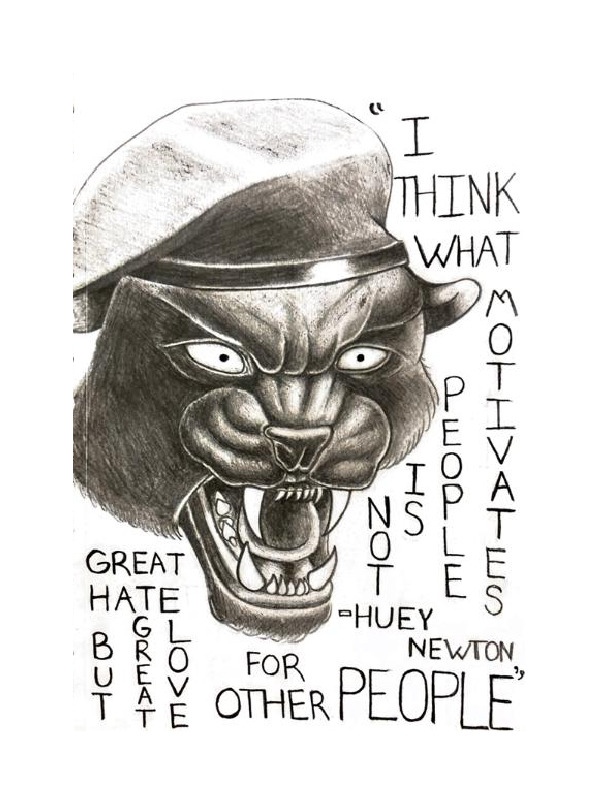
Illustrated by Antonia Flowers
During my time in the Pacific Northwest, I have noticed that there are very few minorities, yet many consume minority culture. If I had a dollar for every time I have heard white kids singing along to Not Like Us, I would have enough money to pay off my student loans. So then why is it that so many minorities feel marginalized, excluded, and discriminated against while here at the UO, despite the fact that our culture is always being put on display? And to answer that question, I am first going to dive into some American history. Particularly the position of Black people in the entertainment industry.
In 1830, a man named Thomas D. Rice smeared shoe polish on his face, put on an outfit, and began to mimic the white idea of Blackness through song and dance, thus giving birth to the minstrel show. The shows were a way to portray African Americans through caricatures justifying the actions and beliefs of white Americans, and exploiting Black pain for entertainment**. **For those who had little to no interaction with African Americans, the shows would be practically the only exposure to Black people they had, leaving the audience thinking that the depictions were accurate portrayals, giving them little reason to see any issue in the systematic oppression around them. For those who owned or interacted with slaves, the shows justified their poor treatment of African Americans by building a popular culture/entertainment source around their oppression.
Later, in 1918, came the Harlem Renaissance. While this era gave birth to many greats like Zora Neale Hurston, Louis Armstrong, Aaron Douglas, and many more, it is also important to recognize the relationship between Black artists and white consumers. For instance, many know the name of the Cotton Club (a nightclub in the Harlem district of New York City) but do not mention the primarily white audience that was attending. It was a place where white people could go to sit amongst other white people and watch African Americans perform. In fact, African Americans were only permitted inside as waitresses or performers with very few exceptions. This set a strict boundary, the entertainment and those who were entertained. The Cotton Club was a place with a plantation themed interior, produced racist imagery on menus, and enforced strict colorism on female performers. Langston Hughes, a poet, novelist, playwright, columnist, and social activist was also one of the few African Americans permitted to enter as a customer. He later denounced the club, describing it as “a Jim Crow club for gangsters and monied whites." elaborating that "strangers were given the best ringside tables to sit and stare at the Negro customers - like amusing animals in a zoo."


Today I feel that not much has changed. Many white Americans will consume African American media, music, and culture, while at the same time upholding racist ideologies and beliefs. If not upholding racist ideologies, popular media archetypes contribute to prejudice many hold towards African Americans. The previously stated people will try to maintain a racial


separation between entertainment and the entertained. This can be seen in situations where white audiences will feel angered if they are not the intended audience of a performance. Such as, when Kendrick Lamar performed at the Super Bowl with a strong pro Black message; it was met with hostility from many, referring to it as a “DEI hire halftime show” or criticizing him for the “lack of diversity” within his performance. I would like to point out that around 53% of players, not including those who are multiracial, are African American, with around 24% of players being white. That begs the question of why many Americans are angered that they are not the intended audience for just one out of the many shows that have been performed since the 1960’s, despite the fact that they are the minority of the players of the field. When Kendrick Lamar directed his performance towards African Americans it broke the racial separation between the entertained and entertainers that many are trying very hard to uphold. This performance should be applauded not only for Lamar’s artistic talent, but also for his political statement and the breaking of this barrier. Though, we should also not consider this progress, as the issue is still very present. To quote Malcolm X, “If you stick a knife nine inches into my back and pull it out three inches, that is not progress. Even if you pull it all the way out, that is not progress. Progress is healing the wound, and America hasn't even begun to pull out the knife.”


The perception of African Americans as entertainment contributes to a strong prejudice many uphold. By separating the entertainment and the entertained to coincide with race, it also reinforces the stereotype that entertainment-(ex: sports, mass media, TV shows, etc.)- is the only field African Americans can exist inside. I strongly believe that if you were to ask a majority of the students attending the University of Oregon to name 5 Black people, they would most likely name 5 entertainers. While it is good to have such representation in the media, especially for Black youth, the issue has become that they are unable to name five Black scholars. Oftentimes the view of Black people through a white lens is solely of entertainment and ignores all of the other amazing contributions African Americans have made to our society, which not only perpetuates ignorance but also hurts African Americans.


When living within a white person's lens, it becomes incredibly difficult to see who you are as an individual and be true to yourself. If you are only viewed as entertainment, never encouraged in academics, entrepreneurship, trades, etc., it only becomes more difficult to find your passion. And even after stepping outside this lens others still wear it, causing them to mistreat you, judge you, withhold opportunities, and make assumptions that can lead to dire consequences. It is within the white lens in which many of us are marginalized, especially within the academic community. My hope for all of the minority readers is that they step into their own lens, find community and accomplish whatever they put their minds to. Though for all of the readers who were unable to name 5 African Americans who are not entertainers, I will give you 10, in no particular order.


    1. Marie Van Brittan Brown (1922-1999): Co-Created the home security in 1966. Including a camera that could look out the peephole of a door, a monitor to view the footage, a speaker to communicate with those outside, and a button to call police.


    2. Frederick McKinley Jones (1893-1961): This man is the reason you can have fresh produce from California and eat it in Washington. He invented the refrigerated truck in 1940.


    3. Katherine Johnson (1918-2020): Her calculations of orbital mechanics were detrimental to the moon landing. She had over a 33 year long career at NASA.


    4. Zora Neale Hurston (1891-1960): a writer, folklorist, anthropologist, and documentary filmmaker. She has written a vast amount of literature including Their Eyes Were Watching God, How it Feels to be Colored Me, Dust Tracks on a Road, and Mules and Men, along with many more.


    5. Robert Smalls (1839- 1915): A US politician who while enslaved during the civil war took command of a confederate ship along with 8 others on board (including his wife and children) and escaped. He then joined the union and was able to provide “shipping routes, mine locations, and the times that Confederate ships docked and departed” (Greg Timmons). I think everyone should look into this man and his story because it is incredible.


6. Crispus Attucks (1723-1770): The first man killed in the Boston Massacre. He was a whaler, sailor, and is regarded as the first man to die in The American Revolution.


7. Madam CJ Walker (1867-1919): Not only was she a social and political activist, she was also the first self made female millionaire in America, employing 40,000 people majority of whom were african american women.


8. Garret Morgan (1877-1963): Inventor of the stoplight and the gasmask. He is the reason you can safely drive through an intersection without colliding with the cars around you.


9. Shania Muhammad (2008-current): The youngest teacher in America. She graduated from the University of Oklahoma at 15 and now teaches a 3rd grade class.


10. Maurice Ashley (1966-current): A Jamaican American chess player who in 1999 earned the FIDE title of Grandmaster, the highest title a chess player can attain.